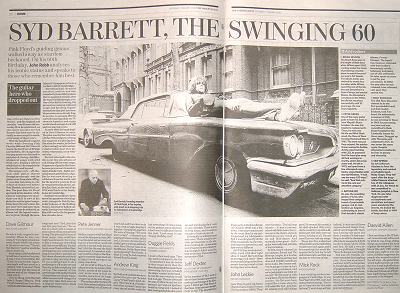
 Syd Barrett, the
Swinging 60
Syd Barrett, the
Swinging 60
Pink Floyd's guiding genius walked
away as stardom beckoned. On his 60th birthday, John Robb analyses his
iconic status and speaks to those who remember him best
Published: 07 January
2006
One of the key
figures of the Sixties - and the original acid casualty - was 60 years
old yesterday. How he celebrated, no one can be too sure, for Syd
Barrett has been seen by virtually no one except his mother for many of
those years.
With the handful of
songs he wrote while fronting Pink Floyd in 1966 and 1967, Barrett was
at the forefront of British psychedelia. He changed the way pop music
was listened to and played, fusing childlike, whimsical songs with wild
freak-outs, forging a vibrant whole that set the template for the late
60s and beyond.
His unique style -
off-the-wall slide guitar shoved through an echo unit - took the guitar
away from plain riffing. It was like listening to the colour of sound
even before Jimi Hendrix arrived in London. The post-Barrett Floyd
operated in his shadow, while a host of contemporary musicians are still
in awe of his plaintive and original songs. It has been 35 years since
his last interview and more than 30 years since he released an album,
but the legend continues to grow, though the man himself disappeared
into a reclusive life in Cambridge.
Barrett had it all -
he was innovative, artistic and surrounded by beautiful women. But he
imploded months after the band's breakthrough, a victim of the hectic
touring, the pressure to come up with new songs and his drug
experimentation that put intolerable pressure on an already fragile
psyche. In autumn 1967 he started behaving oddly on TV shows in America,
and at gigs would stand onstage stock still and not playing a note.
In early 1968, the
band drafted in Dave Gilmour to cover. The plan was for Barrett to be a
Brian Wilson figure, writing the songs but not playing live. But after
five weeks, in the face of increasingly erratic and unreliable behaviour,
they decided, reluctantly, to on without him.
Barrett returned to
the studio to cut two solo albums of sad, lilting off-the-wall songs,
fragments of genius that have become precursors to modern day lo-fi
indie rock - highly personal music poured on to tape. But he was now
starting to withdraw from the world, and for the next few years he lived
in virtual seclusion in his
London
flat, then, at the end of the 1970 went back to the family home in
Cambridge.
Syd Barrett could
have been one of the pantheon of rock legends, alongside Bob Dylan, John
Lennon or the Rolling Stones. Instead he bailed out early, leaving those
who knew him still touched by his genius four decades later.
Dave Gilmour, Pink
Floyd guitarist
He was a truly
magnetic personality. When he was very young, he was a figure in his
home town. People would look at him in the street and say, "There's Syd
Barrett," and he would be only 14 years old.
In my opinion, [his
breakdown] would have happened anyway. It was a deep-rooted thing. But
I'll say the psychedelic experience might well have acted as a catalyst.
Still, I just don't think he could deal with the vision of success and
all the things that went with it.
[On working with
Barrett later]: Roger [Waters, Pink Floyd's bassist] and I sat down with
him after listening to all his songs and said: "Syd, play this one. Syd,
play that one." We sat him on a chair with a couple of mics in front of
him and got him to sing. The potential of some of those songs... they
could have really been fantastic. But trying to find a technique of
working with Syd was so difficult. You had to pre-record tracks without
him, working from one version of the song he had done, and then sit Syd
down afterwards and try to get him to play and sing along. Or you could
get him to do a performance of it on his own and then try to dub
everything else on top. The concept of him performing with another bunch
of musicians was clearly impossible because he'd change the song every
time. He'd never do a song the same twice, I think quite deliberately.
Pete Jenner, Pink
Floyd co-manager 1966-68
My first contact with
Pink Floyd was at the Marquee in June 1966. I had this label and we were
looking for a band that could sell records. I was not really into pop,
but I did like the way the band improvised. I remember walking round the
stage at the Marquee because the stage stuck out, trying to work out
where the noise came from.
All the stuff on
Floyd's first album he wrote in autumn, 1966. In fact, nearly all the
songs he ever wrote were in that six months, and a lot of the songs
cropped up on his solo albums.
The autumn after the
first US tour, there were problems. He'd been wobbling out all sorts of
weird shit, and from there on in it was a real struggle keeping it
together - keeping him together. We were all saying: "We need more
songs" - everyone was putting pressure on him. In the end, it became
obvious that it couldn't go on working, and that's when Dave Gilmour
came in as the fifth man. Did Syd know what was happening? I don't
know... I think in a way he had removed himself from the band.
Andrew King, Pink
Floyd co-manager 1966-68
Syd told me it took
him weeks to perfect the lyrics for "Arnold Layne" [Pink Floyd's debut
single]. There was a lot of intellectual effort involved. I miss him
every day off my life, really. He had everything. He was a songwriter,
painter, actor, charmer. I don't want to talk about him in the past. I
just want to say, "Happy birthday, Syd".
Duggie Fields, musician And Barrett's former flatmate
I went to their early
gigs. They also used to rehearse in the flat - I remember it was the
twists in their music more than the blues they played that made them
interesting. Syd was certainly the major creator in the band - he was
the one everyone would look to at gigs. Then he obviously became
dysfunctional, but the person I saw was not dysfunctional by a long
shot. I looked at their touring schedule a few years ago and was shocked
by it - such a crazy schedule. Throw in a bit of drug abuse, and it
would be enough to freak anyone out.
Eventually, he
withdrew more and more. There would be curtains permanently on the
windows, no fresh air... it seems like in retrospect he was withdrawing,
though it didn't seem like that at the time. I have very fond memories
of Syd.
Jeff Dexter, deejay
at London's legendary psychedelic club, UFO
In the summer of '66,
I went to one of these Sunday spontaneous underground things at the
Marquee. I didn't get Pink Floyd at that time. I was into more straight
rock 'n' roll. The International Times party at the Roundhouse [15
October 1966] was a key event. I was more enamoured by the event than by
any particular band, but I did speak to Syd. I was intrigued by all the
birds round him. At the time, everyone was spaced out, and Syd was no
different.
At UFO, they were on
every other week with their light show. It wasn't like watching an
average rock band - there were people lying on the floor, people dancing
round or just waving their arms about.
John Leckie, record
producer
I saw Pink Floyd at
All Saints Church Hall in Powys Terrace [30 September 1966]. They were fantastic. The hall was minute - it was a nursery school
with little chairs. Everyone sat on the chairs, and now and then people
would get up and idiot-dance. And musically it was great - Syd's guitar
was really loud, with lots of improvisation.
In 1974, they'd
released his solo albums, Barrett and The Madcap Laughs, as a double
album in America
and they had done well. So EMI wanted him in the studio. Pete Jenner
said: "Syd's going to come in, he's not in very good shape, and we're
just going to see what we can get." So Syd came in with new guitars. He
had six Stratocasters - his flat must have looked like a music shop. He
still looked like Syd - long hair, bit unkempt but still looking good.
He seemed bit vacant, a bit shell-shocked. Still, every day he would
turn up with a different girl. But there were no lyrics, nothing at all.
I'm not sure if he even had any songs.
Every day if he
walked out of the studio and turned left he would come back again, and
if he turned right he would disappear. On the last day he left and
turned right, and that was the last we ever saw of him.
Mick Rock,
photographer
I was studying modern
languages at Cambridge. It was New Year's Eve 1966, and I had mutual
friends saying: "You've got to come and see Syd with his band." I went
along and yes, indeed, it was one of those unprecedented things!
Completely out of stage left! There was nothing else quite like them. I
wonder if it had something to do with the chemicals... After, there was
a party at Syd's mother's house, where I first met Syd. He had a very
attractive girlfriend. I thought "Wow! he has got everything!"
Syd was very
friendly. I always remember him laughing a lot - if you look at pictures
I took later in 1971, in the garden in Cambridge, there was a lot of
laughing in them as well. We had a good rapport. The chemicals help
initially with creative people but then the hindrance sets in. The
impression I got when I interviewed him in 1971 was that he didn't want
to be a pop star anymore.
Daevid Allen,
guitarist, The Soft Machine
I first saw them at
the IT festival. I was obviously influenced by what he was doing,
sliding things up and down the neck of guitar. He was pretty - I met him
at [the club] UFO and he would stare right at you. His naive, childlike
songs were for people who wanted to reject the old ways - the generation
which hadn't grown up with the war. It was a glorification of the
innocence of childhood. In the end, Syd ran out of freshness. It got
boring, it wasn't fun any more, so he stopped.
John Robb's "Punk
Rock: The Oral History", will be published shortly by Ebury.
 On
An Island is the third David Gilmour album and his first studio
recording since Pink Floyd's 1994 multi-platinum 'The Division Bell'.
From the first moments of the sound collage that begins 'On An Island',
you know it's a special experience that not only bears comparison with
the best of Pink Floyd, but also confirms their lead guitarist and
singer as an outstanding solo artist. Here he reveals a personal vision
and a breadth of styles – folk, jazz, orchestral and rock – brought
together as a unified piece by his lyrical guitar playing and instantly
recognizable voice.
On
An Island is the third David Gilmour album and his first studio
recording since Pink Floyd's 1994 multi-platinum 'The Division Bell'.
From the first moments of the sound collage that begins 'On An Island',
you know it's a special experience that not only bears comparison with
the best of Pink Floyd, but also confirms their lead guitarist and
singer as an outstanding solo artist. Here he reveals a personal vision
and a breadth of styles – folk, jazz, orchestral and rock – brought
together as a unified piece by his lyrical guitar playing and instantly
recognizable voice.